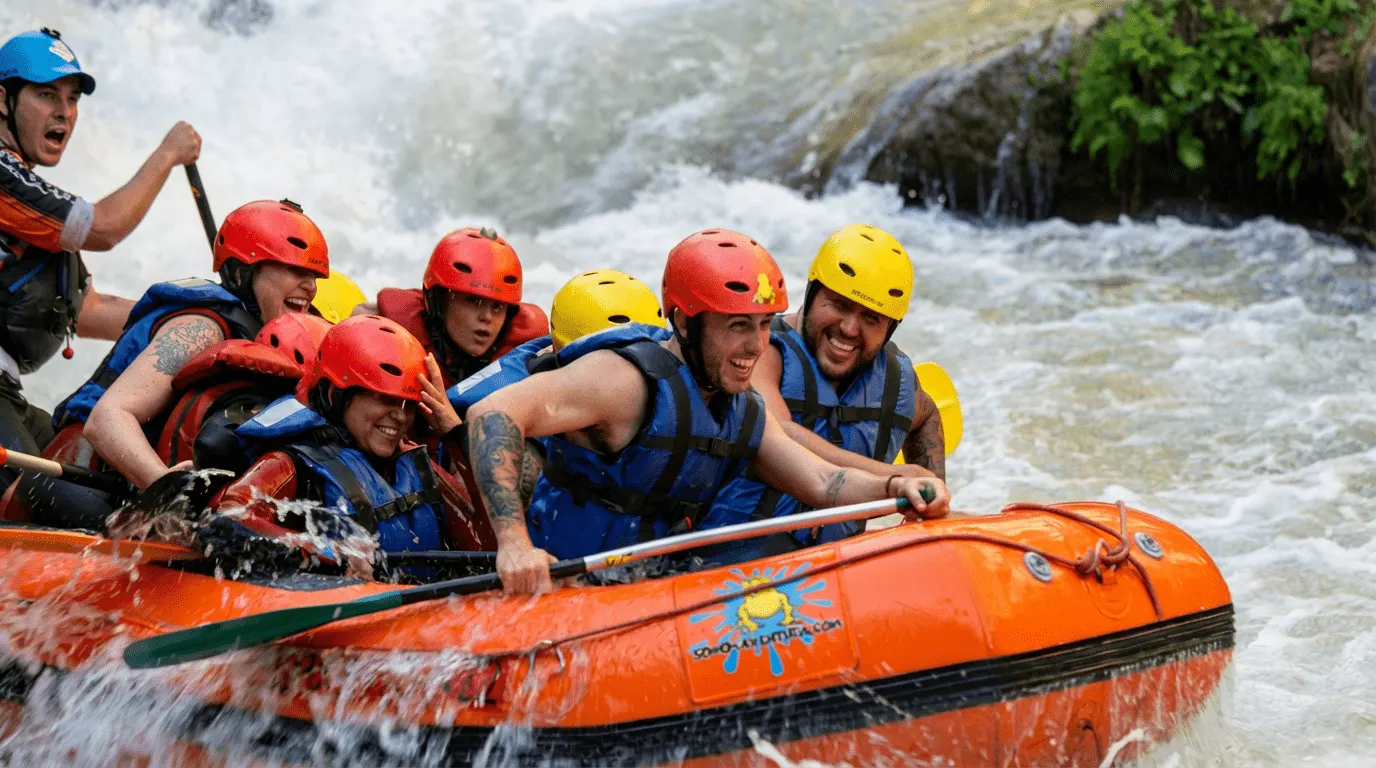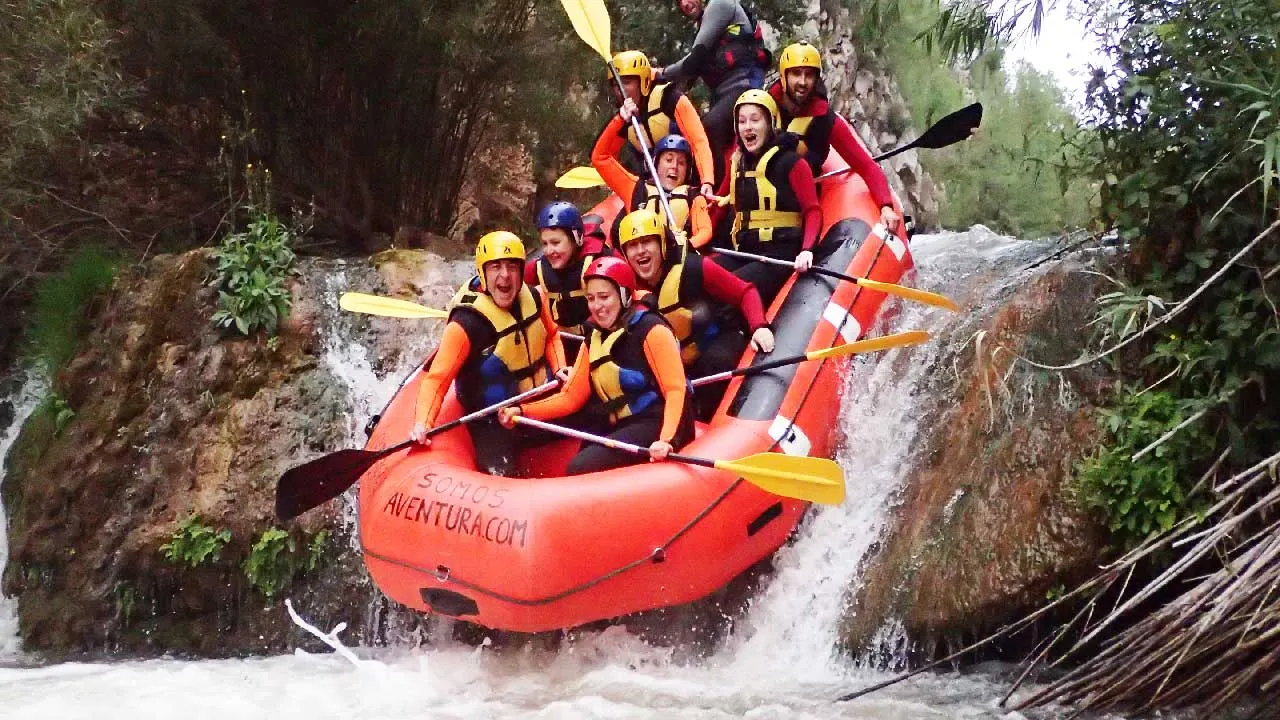
## Surely you have heard the term canyoning on occasion. You may have even been curious to know a little more, so, if you feel like it, we will tell you some things to get you closer to one of the most refreshing and fun adventure sports in the natural environment.
### What is canyoning?
Depending on whether you have ever practiced it or not, your answer will be more or less close to reality. If it is something totally unknown to you, it is very possible that you think it is something for crazy people or high mountain professionals. Well, nothing could be further from the truth. If, on the other hand, you have done it, you will have been able to verify that you were able to do it, you enjoyed it and that yes, anyone without prior experience can do it.
Whatever your case, we will try to expand a little more on the information you have about this wonderful experience that is canyoning. To do this, we are going to answer any questions that may arise before, during and after the activity and thus, break myths, discovering that anyone can enjoy it.
### What is canyoning?
It consists of crossing the bed of a river, or ravine, walking, swimming, jumping, sliding, descending with ropes... In short, overcoming the different obstacles that we will find in our path to complete the route.
To do this we will almost always need basic equipment, such as a helmet, neoprene, booties, vest (if desired), harness, seat pads, non-slip footwear...
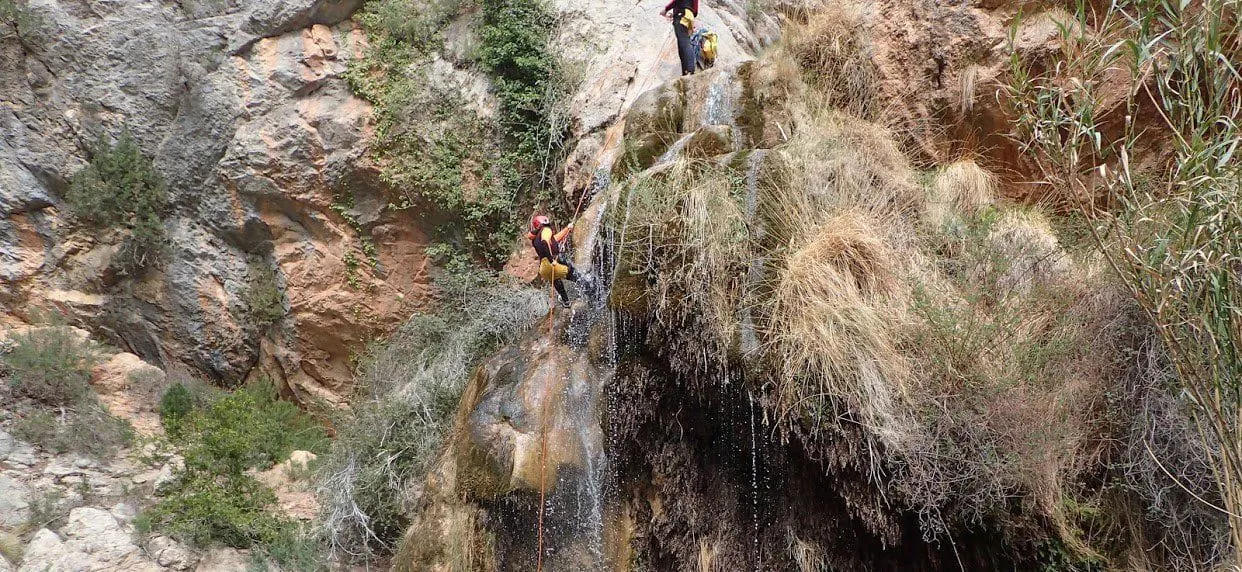
Rivers or their channels may have more or less unevenness, so, depending on this, we may need ropes to be able to overcome jumps that are not deep enough or whose height is considerable and we do not want to risk. The technique of descending the walls is called rapelling.
During the descent we can find pools, which would be something like mini pools that we can jump into (in the case of aquatic ravines).
#### We can also find fun slides, which will allow us to slide thanks to the slides along this stone polished by the erosive action of the water that leaves it soft and slippery.
Among the formations that we can find, are the siphons. These formations that the water creates when trying to find its way downstream are reminiscent of drains that allow water to pass through, but depending on the size of their holes, they can stop the passage of branches and stones and become blocked by floodwaters. Siphons can be a very fun and curious point in our descent, but very dangerous without the supervision of a professional who performs this ravine on a regular basis. They are like mouse traps if you don't know where they are and how to get around them (some may be submerged and you can always, with the guide's instructions, dive to find the exit on the other side).
There are many things to discover, but you better come and discover them for yourself.
### Who can canyoning?
Canyoning is an activity that can be carried out by almost any profile of participant. There are ravines of many kinds and levels, even for children.
What we will always recommend is that you do it in the hands of professionals. A ravine can be simple one day, and the next day become complicated as a result of what the water may have carried with a flood. Don't neglect safety, and don't trust any amateur who "invites" you to do one because he "knows." It is a huge responsibility to take someone into a ravine. Have insurance, means of communication in case of emergency, emergency protocols and intense knowledge of the ravine in question.
### Is it dangerous?
If the necessary security measures are not taken, we will say yes. The main thing is to have the knowledge and experience of a professional guide. This will be our insurance in the experience, along with the use of approved safety material. Let's not take a bike helmet to go canyoning because we have the go-pro attachment and we can record better. In jumping and diving, these helmets, or other activities, are not prepared to dislodge water at such a speed that it does not create pressure on our head, as well as protect sensitive areas such as the ears.
Always trust endorsed companies that work regularly in the area you want to enjoy. Not all canyoners, no matter how expert they may be, know the levels and states of flows, depths of the pools, etc.; of all the ravines, if they are not doing that specific ravine on a regular basis.
### I want to try, where do I start?
You already know that, alone, with friends, as a couple or with your children, you can immerse yourself in the exciting adventure of canyoning anytime you decide. You know you can do it, even if you have no previous experience, and now it's time to choose a ravine for you. Depending on the time of year, we can recommend dry or aquatic ravines, which you can enjoy at any time if you have appropriate equipment. If you are not sure which one to choose, you can ask us when you decide to try it, and we will advise you the best. Remember that prior reservation is always required, so you have to plan things and call to find out everything.
### With or without water?
If water is not your thing, and you choose dry canyoning, we advise you to do it early in the morning, to be careful to apply sunscreen and, as on the beach, to avoid hours of intense sun. As we always say, we know when we start, but not when we finish. Bringing water, some energy bars and protection is ideal.
A ravine with professionals usually has a fairly measured travel time, they don't ask you to get up early to do the damn thing, it's for your own good, if you don't want to have to spend the night in a ravine because you started late. You will make better use of the day and avoid major problems in case things are “delayed” too much and the power ends up going out.
If you like water, you can enjoy the rock formations along the route, its slides, jumps into pools and endless fun obstacles that end in a dip. If the company you choose takes good care of maintaining your body temperature with quality equipment, you will enjoy the activity with pleasure. 5 millimeter wetsuits and the possibility of 2 pieces so that, at a given moment, if you are hot, you can adjust it, it is ideal. Keeping your feet warm with booties and having footwear that grips, such as mountain sneakers or boots, will be your best ally to keep your ankle well supported and avoid sprains.
Did you know that neoprene, apart from preserving your temperature in the water for longer, can do other things? It is an important safety element of several points, one of them is its buoyancy.
#### Have you tried playing dead dressed in neoprene? Hilarious!! And, on the other hand, it prevents rocks and sharp edges from damaging your skin, so long neoprene, yes or yes.
You will also have the protection and sliding effect of the “culeras”. A kind of plastic diaper that will make your butt float on the rocks and slide like a hockey puck without ruining the neoprene.
### The adventure begins
You have finally made up your mind, you book your adventure and you show up at the meeting point. Greetings, nerves, laughter... let's see what's going to happen here. It all starts with the delivery of material that you don't know very well how to place on your body, the zipper in front, the back, this yellow diaper... And you begin to learn, and we will explain to you not only how to place it, what it is for and the differences, curiosities... we will expand your world while you have fun.
### We descend
Neoprene, harness, helmet, harness... You already have everything on and after walking a bit through dreamlike natural landscapes, you arrive at the ravine. You are calm, eager, your heart is racing and after a few jumps and climbs the path is cut off. It's time to use help. The ropes, let's rappel. Rappelling is the technique that consists of descending a wall with the help of ropes to avoid a jump. It is always a safety measure when in doubt as to whether a pool (in the case of an aquatic ravine) may have sufficient depth for the jump to be safe. So, when in doubt, the guides will provide the necessary security so that you can go down without any setbacks, yes... vertigo is not a good ally.
Luckily, not all ravines have rappels, or technicalities with ropes, which is usually what slows down the route the most. Depending on the size of the group, going one by one, with the times each person takes to make the descent (fears, doubts, questions...), can affect the dynamism of the activity for the entire group. In this type of canyoning, small groups of no more than ten participants are recommended. Analyzing the routes and studying their fluidity is essential for the result to be successful. We have studied for groups of all sizes, the complete execution of an aquatic ravine, that of Chillapájaros in Montanejos (Castellón), and we have changed these technicalities for a zip line from the top of the canyon to the water.
#### Optionality is also a point that means that, for any inexperienced person, abandonment is no more torture than doing something they don't want.
Our offer of canyons for everyone has this point of optionality that allows anyone to avoid a situation that is not to their liking and stop doing it without missing the rest of the route.
### What if it rains?
It's a question that comes up every time we book something... is it cancelled? Does it affect the safety of the activity?
We have woken up to a gray day or the forecasts days before point to a downpour that day. It is normal, since there are ravines that can suffer from flooding and we must be attentive to these things. In the case of the Chillapájaros Aquatic Ravine, this situation would not affect it at all. It has an artificial flow coming from the release of the swamp, so the level is always optimal to do it. The only thing different, apart from the fact that the sun is not shining, is that the water can get a little cloudy. For the rest, security remains the same. You will be well equipped with wetsuits in which you will not get cold, and the adrenaline will make you not realize that it is raining until it's over.
### What does it feel like to go canyoning?
If you want to know, you'll have to try it. We can tell you a thousand and one, but nothing like living an experience firsthand at the hands of professionals who have studied every corner of that ravine to make it an experience to enjoy. Every jump, every swim, every vision inside the canyon. Even doing the same canyon several times, you will never feel the same. Were you satisfied with eating a single plate of paella when you tried it? Doesn't it taste different every time? We offer you to go see a part of nature, in a safe, fun way that will teach you, excite you and make you connect with it in a different way.
Do you dare to live it?